
Banks with travel portals walk a tight rope. Hold rates high to fund card benefits, and your card holders book elsewhere. Drop prices to win volume, and you erode the economics that make premium cards viable. Most programs treat pricing as a binary choice between protecting margin and driving bookings.
A leading financial institution approached us with a different question: what if different card holders respond to pricing in fundamentally different ways? Rather than assume uniform price sensitivity across their entire cardholder base, they wanted to measure who would engage when competitive rates validated the portal's value—and who was already captive to the benefits experience regardless.
We explored strategic pricing across their travel portal, measuring booking behavior and value patterns across distinct member segments. The insight we sought: which customers treat the portal as one option among many (and respond to competitive rates), versus which are already committed to the ecosystem regardless of marginal pricing differences.
Cash-paying customers comparison-shop across channels before booking. Point-redemption customers are invested in maximizing the program's currency. Understanding this divide would determine where pricing investment delivers growth—and where benefits optimization matters more.
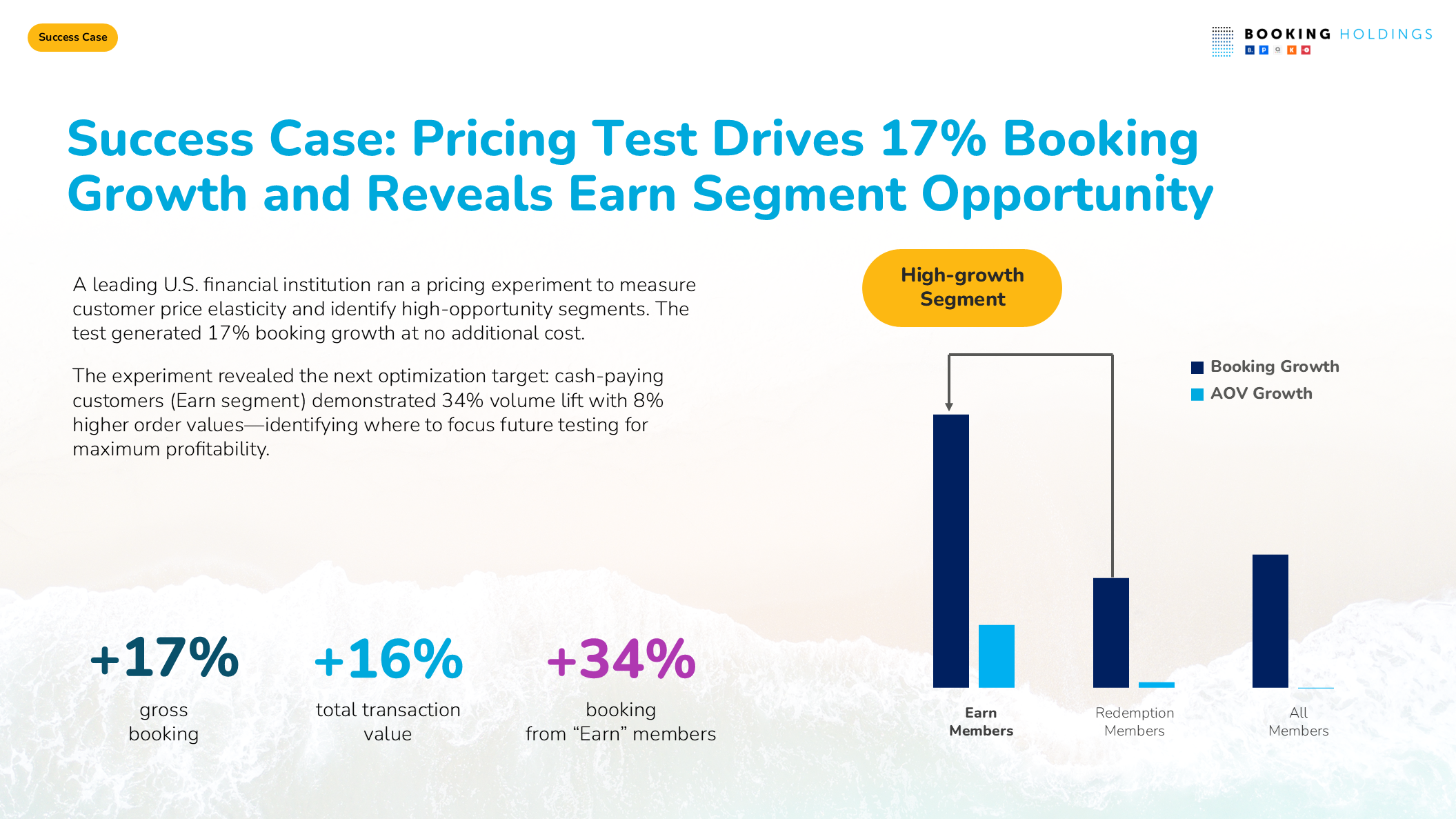
The 17% overall lift masked the real story. Competitive pricing revealed three fundamentally different customer mindsets. Cash-paying cardholders upgraded to premium inventory. Point-redemption card holders, already captive to the earn-and-burn flywheel, stayed put. First-time bookers show 2.7x greater responsiveness than their counterparts.
The feared "race to the bottom" never materialized. Cash-paying customers didn't trade down—they traded up.
When competitive rates validated the portal's value proposition, these card holders actively chose higher-value properties, revealing a segment that seeks value delivery, not subsidies.
The exploration delivered more than metrics—it created a strategic roadmap grounded in customer behavior. Working collaboratively with the financial institution's team, we translated the segmentation insights into three optimization pathways that would enable segment-specific value delivery rather than uniform approaches.
Strategic pricing recaptures wallet share. Competitive rates don't cannibalize other programs; they recapture volume lost to other channels. The opportunity is bringing card holders back into the portal's consideration set when they're actively shopping for travel.

Join our partner network to drive engagement, revenue, and customer loyalty.
Become a partnerTravel portals operated by banks face a defining tension: loyalty pricing - the strategy to dynamically raise hotel prices to help fund accelerators and other card benefits - protects program economics but risks losing members who compare shops and book elsewhere. Over-discount to compete, and you train members to wait for deals while eroding program economics. Hold rates high, and booking volume can stagnate.
We partnered with a leading US airline loyalty program to re-imagine their existing “Boost" feature— enhancing it with new premium booking packages and VIP perks—driving 25-30% attach rates and 30% higher average order values.
Nectar, a leading UK loyalty program, teamed up with Rocket Travel by Agoda to launch Nectar Hotels, a fully branded travel platform for loyalty members

As one of Japan’s most diverse and culturally significant regions, Hyogo Prefecture stands out not only for its world-renowned attractions like the UNESCO-listed Himeji Castle and the historic Arima Onsen, but also impressive scale, with a population of over 5.5 million and attracting over 1.4 million overnight guests per month in 2024.

Founded in 1994, Smiles is the most known frequent-flyer program in Brazil. With a customer base of approximately 17M travelers, Smiles is now the loyalty program for GOL, the largest Brazilian airline. Rocket Travel by Agoda and Smiles have been working together since 2017. The company was the first global partner to leverage Rocket’s leading technology to provide its customers with the option to redeem miles on hotel stays.3.4% increase in email open rate0.6% increase in click-through rate5% increase in direct market share.
Flying Blue, the loyalty programme of Air France, KLM, Transavia, Aircalin, Kenya Airways, and TAROM, and Rocket Travel by Agoda launched a new platform that provides Flying Blue customers with more options to earn and use points on hotel stays. With this launch, Rocket Travel by Agoda has expanded its reach globally, as Flying Blue became Rocket’s second white label partner in Europe.Since launch, bookings have increased by 200%. The customer-centric and partner-branded website, the improved user experience, the expanded option to earn and redeem Miles, and the emphasis on delivering quality support are some of the key reasons why this partnership has been successful.
One leading global aviation company with a successful loyalty program turned to Rocket Travel by Agoda to create a redefined hotel booking experience.The airline market’s profits dropped 33% in Q2 of 2024, amid an increase in labor costs and jet fuel prices. These market conditions are forcing airlines to look at how they can maintain profitability, coming in the form of cutting routes, grounding planes, and finding ways to increase efficiency. Smart airlines are leveraging their loyalty programs to cultivate new revenue streams and achieve their business objectives.

Jim Thompson, the iconic Thai lifestyle brand, aimed to expand its visibility among a diverse, global travel audience. To do so, they needed to place their promotional offers in front of travelers who were actively planning their trips. However, advertising channels tend be imprecise, often showing ads to a general audience instead of people who are actively planning a trip. This can lead to wasted budget and missed opportunities to connect with interested travelers.
